Product guide
School Management Software That Matches Real School Days
The phrase school management software is used broadly—from simple notice apps to full campus suites. This page explains what a serious platform should cover for Indian schools, common pitfalls when tools stay siloed, and how to prioritise modules so your office, teachers, and parents stay aligned.
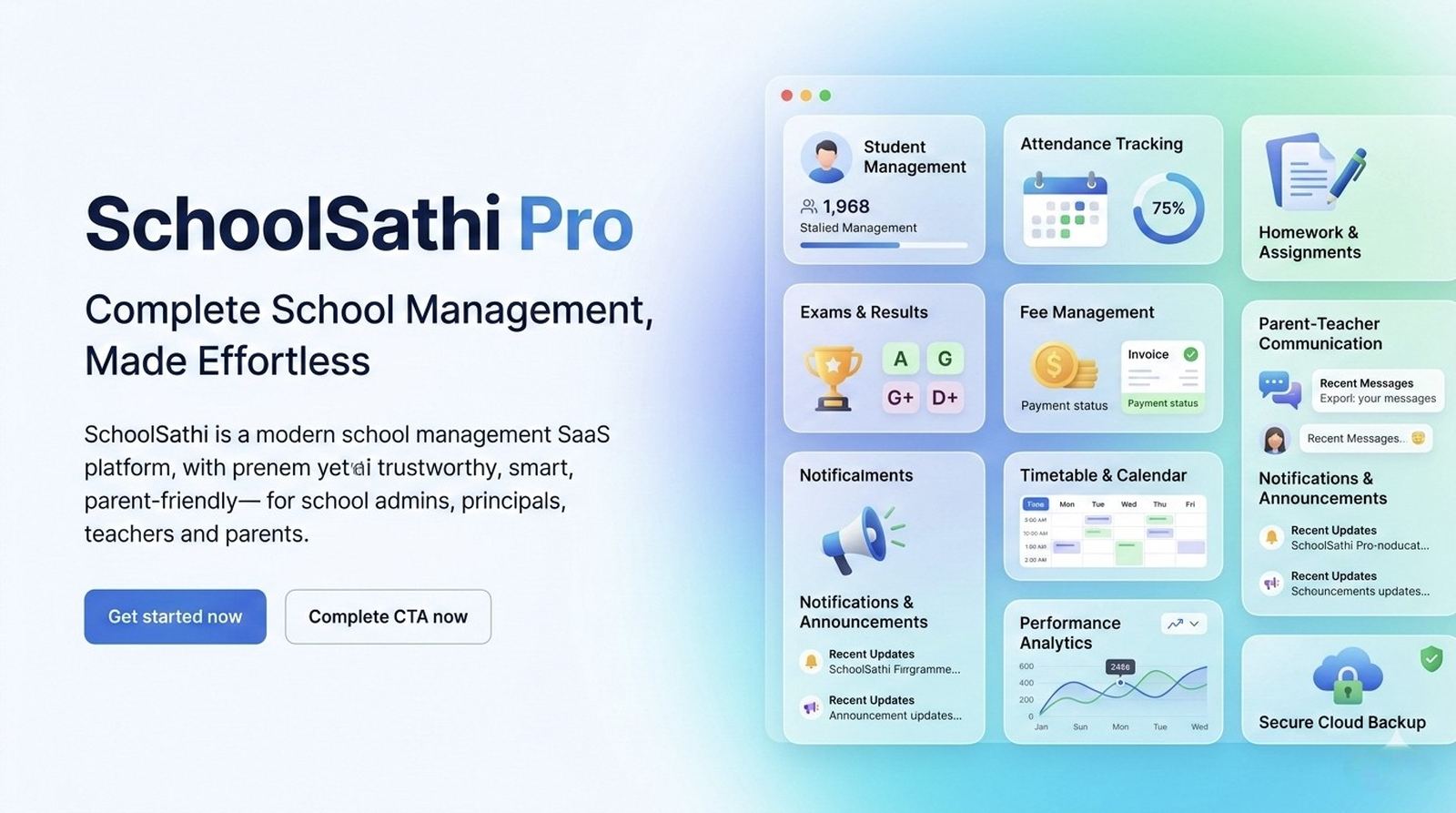
Beyond “digitisation” of registers
Many schools first digitise a single pain point—fees only, or attendance only—and later discover the same student copied differently in another system. True school management software minimises duplicate entry by sharing one student profile across admissions, class allocation, fee plans, attendance, assessments, and parent messaging. That single-source approach is what saves hours during admission season and report card week.
When evaluating products, ask how changes propagate. If a section reshuffle happens mid-year, do attendance registers and fee ledgers update together? If a student withdraws, can you freeze access and retain records for compliance? Answers reveal whether the product is designed for ongoing operations or only for demos with tidy sample data.
Modules that should talk to each other
Front office and admissions
Admissions set identifiers for years to come. Capture structured data—boards, mediums, quotas, transport needs—so downstream teams inherit accurate class lists. Strong software validates duplicates and supports document checklists without forcing parents to resubmit the same information on paper.
Fees and compliance visibility
Indian fee models vary: annual, term-wise, transport add-ons, sibling rules. Your platform should let office staff explain dues confidently at the counter, while leadership sees consolidated outstanding without waiting for manual Excel consolidation. Learn more about aligned pricing on our pricing page.
Attendance and discipline of data
Daily attendance should connect to reports parents recognise. If you plan camera-assisted or biometric flows, pair this page with our explainer on a face attendance system for school deployments where structured controls matter alongside traditional marking.
Exams, results, and communication
Exam masters should reuse subjects and grading schemes so teachers are not maintaining shadow mark sheets. When results publish, parent communication should reference the same roll numbers and class labels used in fees and attendance—reducing disputes and phone traffic.
Benefits leadership actually feels
Principals gain predictable reporting: trends in attendance, fee recovery, and academic performance without waiting for each department to email partial spreadsheets. Administrators reduce reconciliation errors. Teachers spend less time on mechanical data entry. Parents experience clearer, consistent updates—especially when your SchoolSathi Pro deployment includes the parent app alongside office workflows.
For a strategic view of ERP-style integration, read school ERP software India considerations—helpful when you want finance, academics, and communication decisions in one roadmap instead of three parallel projects.
Use cases: who benefits on day thirty and day three hundred
Early wins often come from fee receipts and attendance visibility—parents see professionalism; staff see fewer arguments at the window. Long-term value appears when historical data supports board inspections, scholarship decisions, and staffing plans. Choose a vendor that demonstrates both quick modules and sustained performance after your master data grows messy—because real schools are never as neat as demo tenants.
Training and language comfort matter. Mixed Hindi–English teams should receive practical walkthroughs, not generic foreign playbooks. Support over WhatsApp and phone, aligned to Indian business hours, keeps adoption honest when unexpected scenarios appear during exams or cultural events.
Why teams shortlist SchoolSathi Pro
SchoolSathi Pro focuses on Indian operational realities: connected modules, face attendance options, transparent annual pricing, and downloadable artefacts such as admit cards and ID cards. Explore the full capability map on features, then validate fit with a short demo tailored to your strength and board.
See school management software workflows on a live call—fees, attendance, and parent app in one flow.
Implementation process for Indian schools
Successful projects sequence work: Data preparation (clean student lists, fee heads, class-section mapping). Office-first go-live so receipts and dues look professional before teachers feel pressure. Teacher enablement with short, repeated sessions—not one overloaded Saturday. Exam and results once daily attendance feels “normal.” This mirrors how busy campuses actually absorb change without stopping classes.
Small schools vs large schools: different wins
Compact campuses
Smaller teams feel relief when one school management software replaces three informal tools. The risk is skipping documentation—assign one “process owner” so shortcuts do not creep back into personal Excel files.
Multi-section or multi-campus setups
Larger schools need concurrency controls: who approves fee waivers, who locks attendance, how transport changes propagate. The software must handle hundreds of simultaneous users during peak fee hours without sluggish screens—test during a simulated rush, not a quiet demo.
Compared to other approaches
Paper + WhatsApp: familiar but opaque for audits and trend analysis. Generic CRM tools: rarely understand academic calendars or Indian fee nuances. Multiple single-purpose apps: create reconciliation nightmares. Integrated school ERP software India stacks aim to unify identity and reporting—compare this trade-off honestly with your board.
Checklist before you commit
- Written data export and backup policy.
- Training plan in languages your staff actually uses.
- Attendance policy if you add face attendance later.
- Alignment between finance and academics on master data ownership.
- Success metrics: time to close daily attendance, fee receipt turnaround, parent complaint volume.
Real-world use cases
Fee-heavy season: office clears queues faster when dues and receipts match the parent app—fewer “I already paid” arguments. Board inspection: leadership produces consolidated attendance and fee summaries without overnight compilation. New principal onboarding: historical ERP data explains trends faster than inheriting a pile of folders.
Read more on school ERP vs traditional systems and how ERP reduces school workload on our blog.
FAQ
What does school management software include?
Typically student records, attendance, fees, exams, results, communication, and reporting—ideally integrated so teams avoid duplicate entry.
Can we start with one module?
Yes, but plan integration early. Starting with fees plus student masters often unlocks faster wins than isolated pilots that require later rework.
Is training included?
Confirm with your vendor. SchoolSathi Pro onboarding is designed around phased rollout and practical staff sessions.
How is this different from a free attendance app?
Depth: fee rules, exam workflows, multi-year records, and parent communication tied to official school data—not ad-hoc groups.
Where do I see pricing?
Visit the pricing section for current annual plan details.
Do small schools need the same modules as large ones?
Not always—start with student masters, fees, and attendance; add depth as you grow. The platform should scale without forcing unused complexity on day one.
What is the biggest mistake during ERP rollout?
Big-bang go-live without office buy-in—usually fees and masters should stabilise before academic modules go strict.
See SchoolSathi Pro in a live walkthrough.